
One of the most common questions we hear from injured workers is: “How much compensation could I actually receive?”
The truthful answer is that every claim is different. But that doesn’t mean you’re in the dark. UK courts and solicitors use established legal guidelines to calculate compensation, and understanding how those figures work can give you a realistic picture of what your claim may be worth.
This guide explains how compensation is calculated, provides guideline figures for the most common workplace injuries, and explains what can increase or reduce the amount you receive.
Ready to find out what your claim is worth? Start your accident at work claim today.
How Is Accident at Work Compensation Calculated?
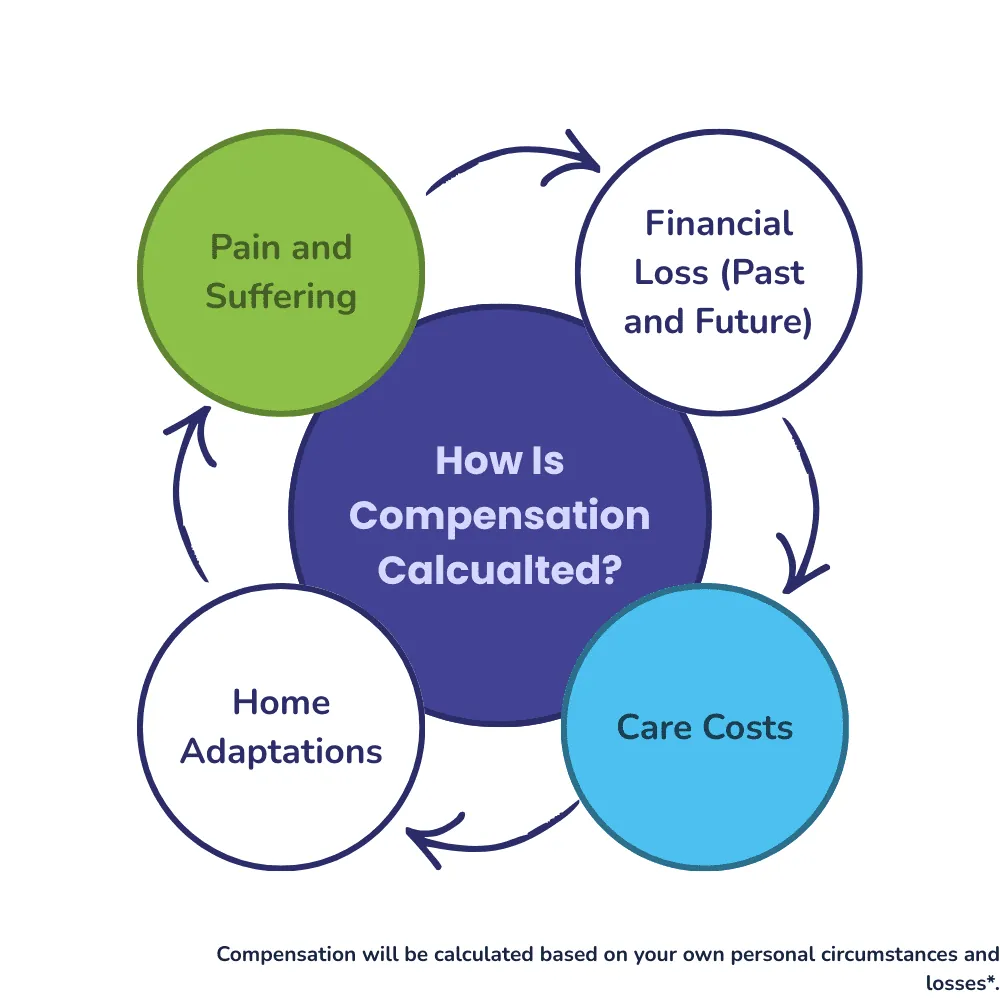
Compensation in a workplace injury claim is divided into two distinct categories: general damages and special damages. Most claims include both.
General Damages
General damages cover the non-financial impact of your injury — specifically:
- Pain and suffering caused by the injury itself
- Loss of amenity — the impact on your ability to enjoy activities, hobbies and daily life
- Psychological impact — anxiety, depression, PTSD or other mental health consequences
These are assessed using medical evidence from an independent expert and valued against the Judicial College Guidelines, 18th edition (2026) — the authoritative legal reference used by courts across England and Wales to determine fair compensation for each injury type and severity.
Special Damages
Special damages cover every financial loss caused by your injury — past and future — including:
- Lost earnings — wages lost while off work and, where relevant, projected future loss of income
- Medical and treatment costs — physiotherapy, surgery, specialist appointments, medication
- Travel expenses — trips to medical appointments and solicitor meetings
- Care costs — paid or unpaid care provided by family members
- Home adaptations — if your injury has affected your mobility or independence
- Pension loss — where a serious injury affects your long-term earning capacity
- Equipment costs — wheelchairs, prosthetics, assistive technology
Special damages require supporting evidence such as payslips, receipts, invoices and medical reports. Our solicitors will help you identify and document every loss to ensure nothing is missed.
Accident at Work Compensation Figures by Injury Type
The figures below are guideline brackets derived from the Judicial College Guidelines, 18th edition (2026), reported court decisions and comparable settled claims. They represent the general damages element only — your total compensation will be higher once special damages (lost earnings, treatment costs etc.) are added.
These are indicative ranges, not promised amounts. The exact figure depends on your specific medical evidence, prognosis and the full financial impact of your injury.
Back Injuries
Back injuries are among the most common workplace injuries in the UK, particularly in manual handling, construction and warehousing.
| Severity | Guideline Range |
|---|---|
| Minor — full recovery within months | Up to £5,750 |
| Moderate — recurring or prolonged symptoms | £16,520 to £51,230 |
| Severe — significant long-term disability | £51,230 to £116,820 |
| Very severe — permanent disability, neurological damage | £120,340 to £212,670 |
Neck Injuries
| Severity | Guideline Range |
|---|---|
| Minor soft tissue / whiplash | Up to £10,420 |
| Moderate — restricted movement, ongoing symptoms | £10,420 to £50,850 |
| Severe — fractures, discs, nerve damage | £60,080 to £195,970 |
Shoulder Injuries
| Severity | Guideline Range |
|---|---|
| Minor — full recovery | Up to £10,420 |
| Moderate — frozen shoulder, limited movement | £10,420 to £16,870 |
| Serious — rotator cuff damage, surgery required | £16,870 to £25,370 |
Hand and Wrist Injuries
| Severity | Guideline Range |
|---|---|
| Minor fracture or soft tissue injury | Up to £6,280 |
| Moderate — fracture with lasting complications | £7,520 to £32,370 |
| Severe — significant function loss | £32,370 to £81,790 |
| Loss of index finger | £16,080 to £24,760 |
| Loss of thumb | £46,930 to £72,440 |
Arm Injuries
| Severity | Guideline Range |
|---|---|
| Simple fracture — full recovery | £8,730 to £25,370 |
| Moderate — complications or incomplete recovery | £25,370 to £51,750 |
| Severe — permanent significant disability | £51,750 to £172,970 |
| Loss of one arm | £127,050 or more |
Leg and Knee Injuries
| Severity | Guideline Range |
|---|---|
| Minor knee injury — full recovery | Up to £18,150 |
| Moderate knee injury — ongoing symptoms | £19,610 to £34,600 |
| Simple leg fracture — good recovery | Up to £18,600 |
| Serious leg injury — multiple fractures | £51,790 to £117,210 |
| Amputation of leg below knee | £129,440 to £175,690 |
Ankle Injuries
| Severity | Guideline Range |
|---|---|
| Moderate — ligament damage, some ongoing issues | £18,150 to £35,130 |
| Severe — significant permanent disability | £41,370 to £66,140 |
Foot Injuries
| Severity | Guideline Range |
|---|---|
| Moderate — lasting symptoms but not disabling | £18,150 to £33,020 |
| Severe — serious permanent disability | £55,450 to £92,520 |
Head and Brain Injuries
| Severity | Guideline Range |
|---|---|
| Minor — no permanent symptoms | £2,920 to £16,870 |
| Moderate — some permanent effects | £56,890 to £289,420 |
| Moderately severe — significant disability | £289,420 to £372,570 |
| Very severe — permanent vegetative state or equivalent | £372,570 to £533,720 |
Eye Injuries
| Severity | Guideline Range |
|---|---|
| Minor — temporary loss of vision | £2,910 to £11,540 |
| Serious — significant permanent vision loss | £31,290 to £51,990 |
| Total blindness in one eye | £65,090 to £72,440 |
| Total blindness both eyes | In the region of £355,020 |
Psychological Injuries
Psychological injuries — including anxiety, depression and PTSD following a workplace accident — are fully compensable as either standalone claims or alongside physical injuries.
| Severity | Guideline Range |
|---|---|
| Minor — full recovery within 1–2 years | £2,040 to £10,810 |
| Moderate — significant symptoms, good prognosis | £7,740 to £30,580 |
| Moderately severe — marked problems, limited improvement | £25,190 to £72,440 |
| Severe — permanent significant disability | £72,440 to £152,900 |
Life-Changing and Catastrophic Injuries
For the most serious workplace injuries — including spinal cord damage, brain injury with permanent disability, loss of multiple limbs or permanent vegetative state — compensation can range from £100,000 to over £500,000 for general damages alone. When lifetime care costs, loss of future earnings and specialist equipment are added as special damages, total settlements in catastrophic injury cases regularly exceed £1 million.
What Increases Your Compensation?
Several factors can significantly increase the value of your claim beyond the base injury bracket:
- Long-term or permanent disability — where the injury affects your capacity to work or live independently for years to come
- Ongoing symptoms — pain, restricted movement or neurological effects that persist after the initial recovery period
- Surgery required — particularly where multiple procedures are needed or complications arise
- Psychological impact — PTSD, anxiety or depression following the accident, especially where this is diagnosed and documented by a specialist
- Career impact — inability to return to your previous role or profession, or reduced earning capacity going forward
- Young claimants — injuries sustained early in a career attract higher compensation for future loss of earnings
- Care needs — where a family member has given up work or significantly reduced their hours to care for you
In serious and life-changing injury cases, claims regularly include future care costs projected over a lifetime, and expert actuarial evidence is used to calculate the full financial impact.

What Reduces Compensation?
Your compensation may be reduced in certain circumstances:
- Contributory negligence — if you were partly responsible for the accident (for example, not wearing provided PPE), your compensation may be reduced proportionally. However, you can still make a valid claim even if the accident was partly your fault.
- Pre-existing conditions — if a pre-existing medical condition is aggravated rather than caused by the accident, compensation covers the worsening of that condition rather than its full extent
- Failure to mitigate — if medical advice is not followed, or recommended treatment is refused without good reason, this can affect the value of a claim
Real Cases — What NJS Law Has Secured
Understanding compensation in the abstract is one thing. Seeing real outcomes is more useful:
- £3.7 million — secured for a client seriously injured in a forklift accident at work, covering lifetime care, loss of earnings and specialist equipment
- £33,000 — awarded after a client was injured on an overseas work assignment
- £18,000 — recovered for a preventable arm injury caused by inadequate workplace safety
- £9,500 — secured after a leg injury involving a pump truck in a warehouse setting
- £4,000 — awarded after steel fell on a worker’s head due to poor safety precautions
Every case is different, but these outcomes reflect what is achievable when a claim is handled correctly from the outset.
Frequently Asked Questions
Can I claim if the accident was partly my fault?
Yes. Even if you were partly responsible, you may still receive compensation under contributory negligence principles. Your compensation may be reduced to reflect your share of responsibility, but you are not automatically prevented from claiming. Employers still have a legal duty to provide a safe working environment regardless of employee conduct.
What if the accident wasn't recorded in the Accident Book?
You can still bring a claim. While accident book entries are helpful evidence, they are not essential. Medical records, witness statements, CCTV footage and photographs can all support your case. It is advisable to notify your employer in writing as soon as possible if the incident was not formally recorded.
How long do I have to make an accident at work claim?
In most cases, you have three years from the date of the accident to start court proceedings. If your injury developed over time — for example, a repetitive strain injury — the three-year period may begin from the date you first became aware that your condition was work-related. There are exceptions for children and individuals lacking mental capacity. You can read a full guide on accident at work time limits.
Can my employer dismiss me for making a claim?
No. It is unlawful for an employer to dismiss or treat you unfairly for pursuing a legitimate personal injury claim. If your employer takes adverse action against you for exercising your legal rights, this may amount to unfair dismissal or victimisation. Read more in our guide on being sacked for making an accident at work claim.
Will claiming compensation affect my job?
Most workplace accident claims are handled by the employer’s liability insurer — not directly by your employer. Professional employers understand that insurance exists for this purpose. The claim process is designed to be separate from the employment relationship.
How long does an accident at work claim take?
Straightforward claims with clear liability can settle within a few months. More complex cases — particularly serious injuries or disputed liability — can take longer. Our solicitors keep you updated as your claim progresses and negotiate a settlement on your behalf as efficiently as possible.
Speak to NJS Law Today
If you have been injured at work, early legal advice makes a real difference to the outcome of your claim. Our specialist accident at work solicitors can tell you:
- Whether you have a valid claim
- What your claim is likely to be worth based on your injury and circumstances
- How the No Win No Fee process works
- What steps to take next to protect your rights
There is no obligation to proceed — just clear, professional advice from solicitors who handle workplace injury claims every day.
No Win No Fee: The law limits our success fee to 25% of the compensation for pain, suffering and loss of amenity and for past financial losses, after any state benefits are repaid. Compensation for future losses is not counted. If you win, our success fee is deducted from your compensation. It is a percentage of our basic charges, and the law limits it as set out above. Any After the Event insurance premium is payable only if you win, and is never charged upfront. Your letter of engagement sets out exactly what you will pay for your type of claim, and we explain it before you sign. If you lose, you pay us nothing. This applies as long as you keep to your responsibilities under the agreement. You may have to pay costs if you end your claim early, fail to beat an offer the other side made, or a court finds your claim dishonest or exaggerated; where we have arranged After the Event insurance, it covers some of these costs if you keep to the policy's terms. See exactly what you pay.
Tell us what happened using the enquiry form on this page.
Thinking about a claim? Read about Accident at Work Claims and how No Win No Fee works, or send us your enquiry.